Microsoft Power BI · 2024–2025
Copilot for Power BI
Business users with little data analysis experience find Power BI overwhelming, leaving much of their business-critical data inaccessible. I led vision, roadmap and implementation for a full-page Copilot chat that lets them ask questions and get answers in plain language.
Role
Lead designer
Team
10 engineers, 1 PM, plus partner design teams
Shipped
Private preview 2024, public preview 2025
Shown here
Approach and reasoning only
The standalone Copilot experience in Power BI is public and documented by Microsoft. My working material — explorations, internal research, roadmap and metrics — is confidential at this stage, and therefore isn’t reproduced on this page.
1. Who is this for?
Power BI’s mission is to enable everyone to do more with data. In practice, the product was built for analysts: people who write complex code, know where data lives, and can interpret it.
Our business users are none of those things. Product managers, CEOs, marketers, are people who ask, understand, decide, then act. But in order to make data-driven decisions, they have to currently message an analyst and wait to get their questions answered.
In 2024 we set out to use generative AI to close that cumbersome gap between question and answer, which became the immersive Copilot surface. We sprinted to an MVP that year and launched to public preview in 2025.
2. Shipped to Private Preview
A year after the team defined the original persona, journey and vision, I joined and landed the tactical design work to ship to Private Preview.
Though the experience was functional, it was not yet transformative. It answered straightforward questions but didn’t remember anything, couldn’t hold a thread, and didn’t reason. People expect more than that from their LLMs.
So I stepped in to take us to the next level…
Immersive UX strategy: reset & visioning
The questions
How does what we’ve delivered align with our original goals? What have we learned since? What has changed in the product, the industry, the team, or the underlying technology? How does our intended direction compare to where we’ve actually landed?
The format
A memory workshop to reground the team in the original strategy work, then affinity mapping and voting on “how might we” themes, then a principles brainstorm and vote. The attendees were 30+ cross-functional teammates and partner design teams.
The output
A UX-led product strategy and a two-to-three year vision to feed into the next semester’s planning.
Asking whether we were still aimed at the right thing is not a popular meeting to call a year after launch, with a roadmap already written. But it was the most useful thing I did on this product.
3. Why UX led here
I co-wrote the strategy document that came out of this. The argument in it was that the shift in how business users get answers from data was going to happen with or without Power BI, and that design was the difference between Copilot feeling like a chatbot and becoming a trusted thought partner people relied on.
The engineering-first mode of the team combined with the chaotic high velocity nature of the LLM industry meant that the quality of the model was what was being iterated on the most, rather than the quality of the actual conversation.
4. Where the work went
The strategy set out where to invest. Each of these started as a user problem, not a feature idea.
Strategic areas of investment
01
Conversationality
The UX flattened what generative AI is good at. People got stiff interactions that felt more like querying a database than talking to a teammate. Language is the technology’s actual strength and the interface should reflect that.
02
“Why” instead of “what”
Copilot would give a data answer and stop, leaving the business user to do the hard reasoning alone. We needed to shift it from an answer engine to a reasoning engine: root cause, hypotheses, attribution.
03
Personalisation & memory
Every session started from scratch. People repeat themselves and never build momentum, which is both cumbersome to restart and erodes trust in how intelligent the system is. We must remember past conversations, metrics, segments, questions, and goals.
04
Unified multimodal UX
The experience was fragmented across surfaces that felt like separate tools, forcing people to relearn patterns when they switched context. One fluid experience spanning chat, summary, visuals and drill-down.
05
Telemetry & satisfaction
We needed to better understand how people were actually using it. We didn’t have data on conversation flow, drop-off, or satisfaction. Make logging and CSAT a launch requirement on every project rather than an afterthought.
06
Start where users are
Many people didn’t know Copilot existed, or tried it once and saw nothing worth returning for. Discoverability is critical, and the first interaction with it must earn a second one.
5. Detailed design work
Alongside the vision work I specified the components the experience is assembled from: the anatomy of a chat input and a chat output, scrolling, citations, etc.
Citations and references took the most work. When a system answers a business question, the answer is worth nothing unless the person can see where it came from and decide whether to believe the answer and trust the tool overall.
6. What shipped
The standalone Copilot experience is now available in Public Preview in Power BI as a full-screen chat that finds data and answers questions across any report or model a person has access to, rather than just the one they have open. It is on by default, and it runs on mobile.
Copilot in Power BI — standalone experience
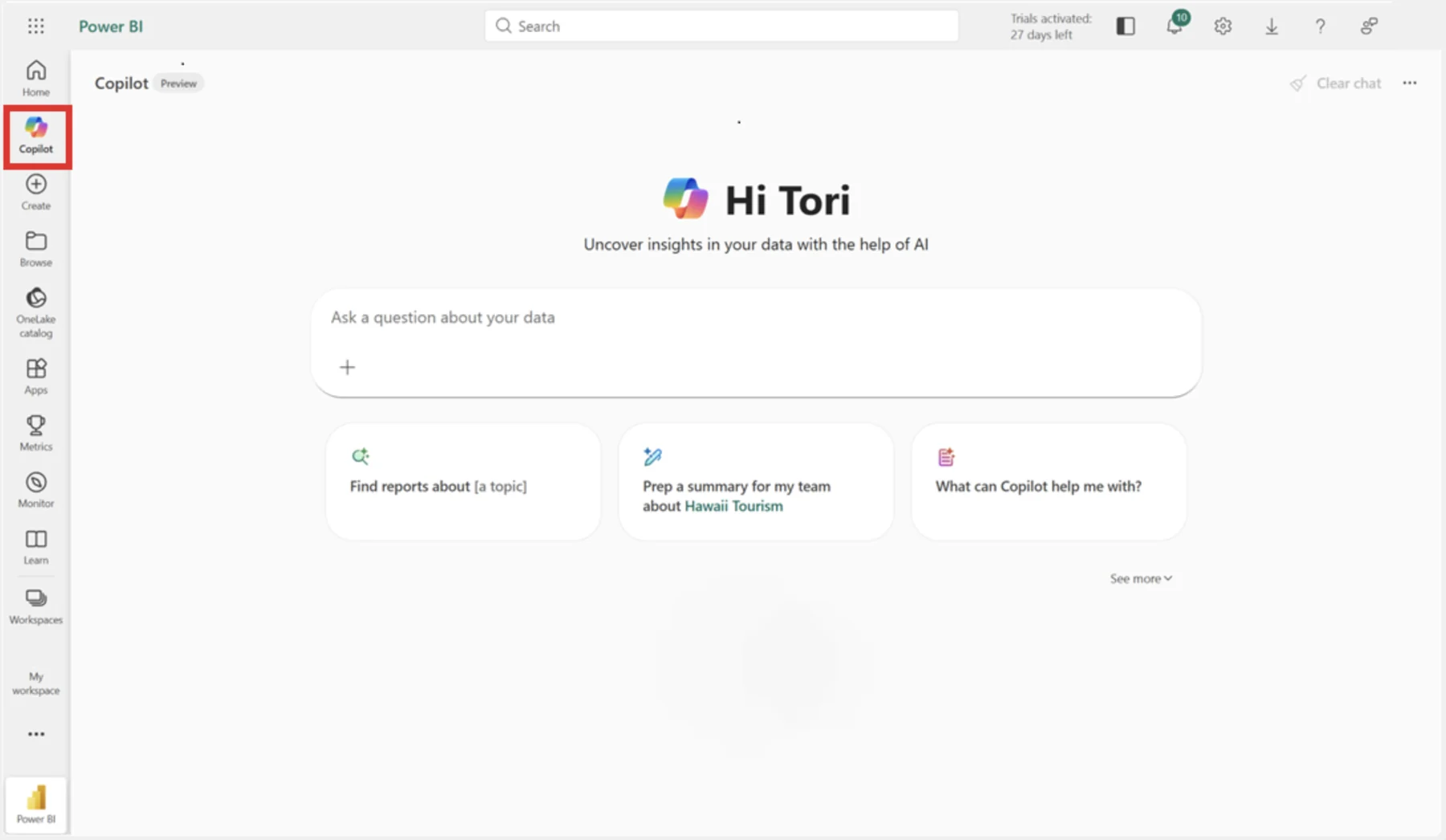
Now our business users who don’t write code or do heavy analysis can ask business questions in their own words and get an answer they can act on, without waiting on anyone.